


|
|---|


Showing posts with label locomotive. Show all posts
Showing posts with label locomotive. Show all posts
Tuesday, March 15, 2011

Inaugurated in the early 80's, the TGV routes serving Lyon and Paris, after the success of its route and then added to other cities in France and even into other countries. The train was built by Alstrom SA - the second largest train manufacturer in the world. Train a new generation of V-150 TGV speed record for conventional wheeled trains at a speed of 515 km / hour. The train uses a supercharged engine and a great deal of train wheels. His new record when it reached 574.8 miles per hour.


The fastest trains Germany
InterCity Express (ICE)


In the early 90s Germany inaugurated the fast train to serve the route Hanover, Wurzburg, Mannheim, and Stuttgart. The train was built by Siemens and reach speeds of 280 miles / hour.
Transrapid


Germany also built his own Transrapid maglev train can reach speeds of 550 miles per hour but unfortunately never had an accident in September 2006 near the town of Lathen and killed 23 passengers.
 As a mode of transportation these superfast trains have many advantages. Transports a large power and most importantly with the same comfort, pollution generated can be one-tenth smaller than by plane. These trains are still using conventional wheels but with a sophisticated machine and the latest using superconducting magnetic technology Levitation (maglev train) that float above the rails.
Fast Train Jepang !
Tokaido Shinkansen - Japan
Japan shocked the world by launching a fast train Shinkansen (bullet train) in 1964 to serve the route Tokyo-Nagoya-Osaka-Kyoto, and speed "only" around 201 km / h (in the year already the fastest).

WIN 350 Eksperimental:

JR E3

JR E4

Each track has its own names (Tokaido, Tohoku, etc.), and each type of train is identified by a nickname (Nozomi, Hikari, etc.). Almost 40 years since it first launched, Shinkansen already carry 6 billion passengers without a significant accident. Shinkansen route also has a very high frequency, such as routes Tokyo and Shin-Osaka passable six trains a hour.
JR 300


"Hikari" means "light", is the first service on the route Shinkansen Tokaido / Sanyo. Since the emergence of Nozomi trains, currently provides a mid-level service with a few extra stops, but still with high speed. Hikari trains linking Tokyo and Osaka in approximately 3 hours. His appearance is more nuanced than the supersonic jet train, with a futuristic design and exceptional comfort.


Variations JR 500


Means "hope", Nozomi trains it only takes 2.5 hours to travel the Tokyo-Osaka, and 5 hours up to all destinations in the southernmost tip of the island in Hakata (Fukuoka). Train paths in this Japanese commercial support mobilization dense population in these areas, although to run it each train would cost up to $ 40 million.


JR 800 Series Latest


Special "Storm Troopers":


JR-Maglev MLX01


These include the type of wagon trains superconducting magnetic Levitation - maglev (floating above a magnetic rail) and the test try capable of reaching speeds of 581 km / hour and so far not been used commercially. China took a step forward with first lebh operating maglev train this type in 2004.


Tuesday, June 29, 2010
The train is the transportation of vehicles with the power of motion, either walking alone or bundled with other vehicles, which will be or are moving on rails. The train is a means of mass transportation that generally consists of a locomotive (vehicle with a power walk on his own motion) and a series of cart or carriage (coupled with other vehicles). Circuit train or car is relatively broad size so it can accommodate a passenger or goods on a large scale. Because of its nature as an effective mass transport, some countries try to use as a maximum as the main mode of transportation both inland transportation within the city, intercity, and interstate.

History
The same history as the history of railway transportation is generally beginning with the discovery of the wheel. Originally known as horse-drawn carriage which consists of only one train (circuit), then made the carriage which attracts more than one circuit and running at a certain point which is made of iron (rails) and is called gauge. This is used especially in mining areas where there are lorries which is bundled and drawn by horse power.
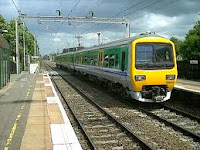
When James Watt discovered the steam engine, Nicolas Cugnot making three-wheeled vehicles fueled steam. People refer to the vehicle as an iron horse. Then Richard Trevithick made locomotive engine coupled with the carriage and use it on the show in front of the public. George Stephenson, who won the race to improve racing locomotive locomotive and used in Liverpool-Manchester line. At that time steam locomotive that used constructed grasshopper. Completion for the improvements made to obtain a more effective steam locomotive, a big powerful, and able to train more attractive.

The discovery of electricity by Michael Faraday made several discoveries that followed the discovery of electric equipment electric motors. Electric motor is then used to create a trolley which is the origin of electric railways. Then Rudolf Diesel diesel trains create a more powerful and more efficient than steam locomotives. Along with the development of electric and magnetic technology is more advanced, made magnetic trains that have speeds above the normal train speeds. Japan in the 1960s Super Express Train operates Shinkanzen with the Tokyo-Osaka route that eventually developed that covers all of Japan. Then the French operate trains with names similar to the TGV.

History
The same history as the history of railway transportation is generally beginning with the discovery of the wheel. Originally known as horse-drawn carriage which consists of only one train (circuit), then made the carriage which attracts more than one circuit and running at a certain point which is made of iron (rails) and is called gauge. This is used especially in mining areas where there are lorries which is bundled and drawn by horse power.
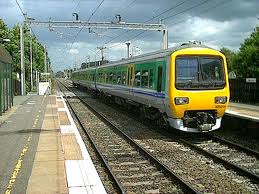
When James Watt discovered the steam engine, Nicolas Cugnot making three-wheeled vehicles fueled steam. People refer to the vehicle as an iron horse. Then Richard Trevithick made locomotive engine coupled with the carriage and use it on the show in front of the public. George Stephenson, who won the race to improve racing locomotive locomotive and used in Liverpool-Manchester line. At that time steam locomotive that used constructed grasshopper. Completion for the improvements made to obtain a more effective steam locomotive, a big powerful, and able to train more attractive.

The discovery of electricity by Michael Faraday made several discoveries that followed the discovery of electric equipment electric motors. Electric motor is then used to create a trolley which is the origin of electric railways. Then Rudolf Diesel diesel trains create a more powerful and more efficient than steam locomotives. Along with the development of electric and magnetic technology is more advanced, made magnetic trains that have speeds above the normal train speeds. Japan in the 1960s Super Express Train operates Shinkanzen with the Tokyo-Osaka route that eventually developed that covers all of Japan. Then the French operate trains with names similar to the TGV.
Subscribe to:
Posts (Atom)


